When we think about preventing family violence, we often think about education campaigns or workplace policies. While these are important, lasting social change also happens when community members see people they know modelling new possibilities.
That is why the Community, Respect and Equality (CRE) Alliance works with local community champions to share authentic stories that challenge harmful gender stereotypes and promote healthier, more equitable communities.
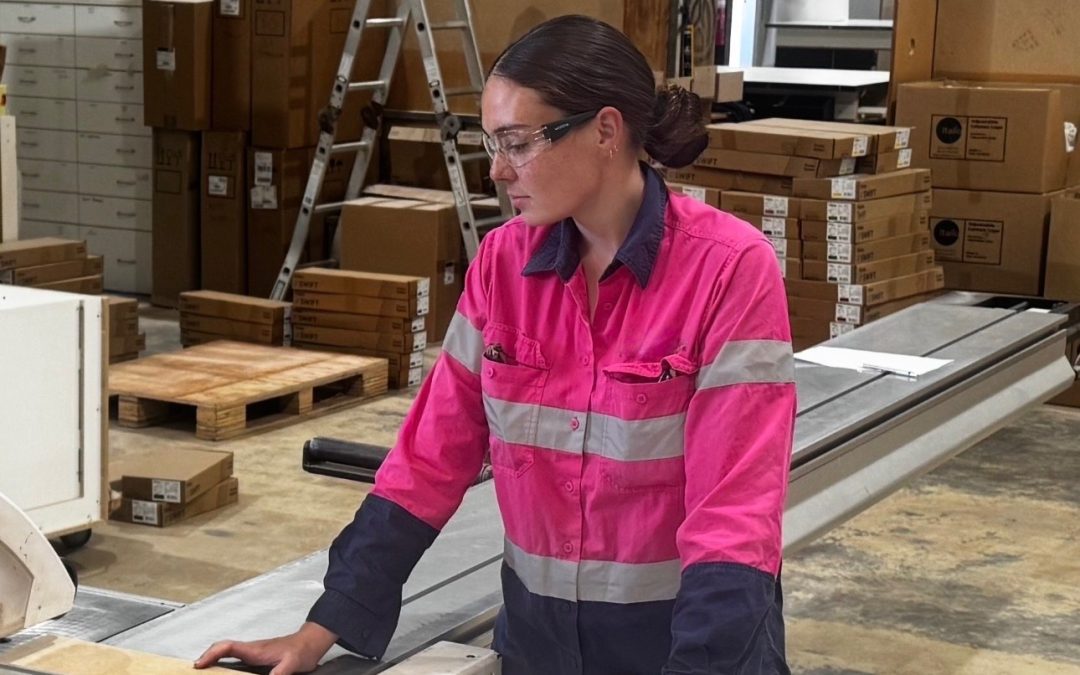
One such champion is Rashaan, a Kija Bardi woman, who grew up in Geraldton and recently fulfilled her dream of becoming a qualified carpenter.
From an early age, Rashaan knew she wanted a career that was hands-on. “From the beginning, I knew I wasn’t built for a desk or a life spent sitting still. Every time I imagined it, I felt that sinking boredom in my chest, so I followed my instincts and chose carpentry.”
Her journey, however, was far from straightforward. As a young Aboriginal woman working in a traditionally male-dominated industry, Rashaan experienced sexism, racism and homophobia. Rather than allowing these experiences to define her, she remained focused on her goal.
She describes the vision of becoming a qualified tradesperson as the motivation that kept her moving forward. Along the way, she also discovered the strength that comes from community, learning from people of different backgrounds and gaining resilience through every challenge.
Rashaan hopes her story encourages other Aboriginal women to believe in themselves and pursue careers they may never have thought possible.
“You can do anything you set your mind to, no matter what statistics say or what anyone thinks. I made it through, and you can too.”
Why stories like this matter
Stories like Rashaan’s do more than celebrate individual achievement. They help reshape what our community sees as possible.
Research into behaviour change consistently shows that positive role models can influence attitudes and social norms. When local people challenge stereotypes and share their experiences, they create opportunities for others to reconsider long-held assumptions about gender roles, careers and leadership.
Within primary prevention, this approach helps build healthier social norms by making equality visible and relatable. Instead of simply telling people what gender equality looks like, community members can see it lived out by people they recognise and respect.
This is a key part of CRE’s communication strategy: partnering with local champions whose lived experiences reflect the values we are working to promote across our community.
Reaching beyond the usual audience
The campaign demonstrated the power of community-led storytelling to reach people well beyond CRE’s existing networks.
The video received more than 20,000 views, reaching 10,675 unique viewers. Most significantly, over 18,000 views came from people who were not already following CRE, showing the story successfully reached audiences beyond our traditional organisational networks. The post also generated 292 engagements, demonstrating that authentic local stories encourage people to stop, watch and interact.
These results highlight an important lesson for community-led prevention. When local people tell authentic stories, they often resonate far beyond organisational audiences, helping introduce conversations about gender equality to people who may not otherwise engage with prevention messaging.
The impact on the storyteller
While the campaign reached thousands of people online, its impact was also deeply personal. Following the campaign, Rashaan shared that she was overwhelmed by the encouragement and support she received from the community. She expressed her gratitude to the CRE team for providing the opportunity to share her story and connect with others.
Sometimes the most powerful outcome of community-led communication is not only the messages it sends, but the confidence it builds in those willing to step forward and lead by example. As more local champions like Rashaan share their stories, they help create a community where challenging stereotypes becomes normal, equality becomes visible, and everyone can imagine new possibilities for themselves and others.
At CRE, we believe social change happens one conversation, one story and one local champion at a time.